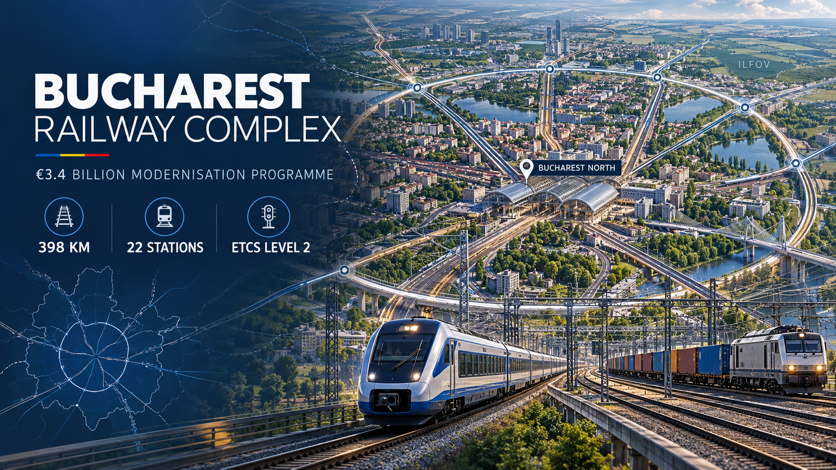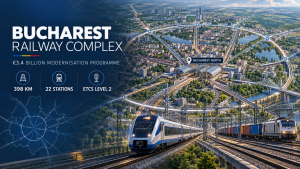
On 9 October 2026, the Romanian Government approved the technical and economic indicators for the modernisation of the Bucharest Railway Complex, one of the country’s largest railway infrastructure programmes. The investment is estimated at RON 17.89 billion, approximately EUR 3.4 billion, including VAT. Of this amount, around RON 9.75 billion is allocated to construction and installation works. The implementation period is estimated at 60 months. The approval does not yet represent the launch of a public procurement procedure. It does, however, establish the technical scope, investment value and general financing framework required for the Romanian railway infrastructure manager, CFR, to advance towards procurement and implementation. A Project Extending Far Beyond Bucharest North Station The Bucharest Railway Complex is Romania’s largest and most intricate railway junction. It includes the infrastructure serving Bucharest North Station, the capital’s railway ring and the connections between this ring and the principal railway corridors entering the metropolitan area. The approved programme covers approximately 398 kilometres of railway, expressed as single-track equivalent length. This figure should not be confused with the geographical length of a single route. The original feasibility study examined approximately 605.7 kilometres of developed track, while the approved indicator refers to the infrastructure selected for modernisation or construction. The programme is expected to include: The feasibility study was prepared by the ISPCF–Baicons Impex consortium under a contract valued at approximately RON 20.74 million, excluding VAT. Strategic Importance for Passenger and Freight Transport The project is not merely a metropolitan mobility investment. Five of Romania’s eight principal railway lines converge in the Bucharest railway node. The complex connects the Rhine–Danube Corridor, including the Constanța–Bucharest–Curtici route, with railway connections towards Giurgiu and Bulgaria, Brașov and central Romania, Moldova and the western border. A modernised railway ring could allow freight trains to bypass some of the heavily congested sections around Bucharest North Station. This would be particularly relevant for freight movements between the Port of Constanța, Giurgiu and Central and Western Europe. The project is therefore expected to: The programme also creates the technical conditions for a more coherent metropolitan rail system. Its success will nevertheless depend not only on infrastructure works, but also on future service planning, suitable rolling stock and effective integration with Bucharest’s public transport network. Financing and Procurement Status The Romanian Government has indicated that financing will be provided through the Transport Programme 2021–2027, the national budget and other legally available sources. Several essential procurement details have not yet been published: The approval of the technical and economic indicators should therefore be understood as a decisive preparatory milestone, rather than the commencement of construction. The next stages should include the operationalisation of the Government Decision, confirmation of the available financial allocations, adoption of the procurement strategy and publication of the corresponding procedures by CFR. Given the programme’s scale and technical diversity, implementation is likely to be phased and divided into several contracts. This remains an informed expectation, however, until CFR publishes the formal procurement strategy. A Major Opportunity for the Railway Construction Market The Bucharest Railway Complex will require multidisciplinary consortia capable of covering railway infrastructure, civil engineering, electrification, signalling, telecommunications and systems integration. Potential areas of professional involvement include: International contractors and engineering companies interested in the programme will require strong Romanian partners capable of navigating local eligibility requirements, public procurement procedures, technical authorisations and the mobilisation of qualified local experts. For M Infra Design & Management, the project is closely aligned with our experience in railway tender management, technical coordination, supervision and the organisation of international–Romanian consortia. The most effective preparation should begin before the publication of the tenders. At this stage, interested companies should identify complementary partners, reserve key experts, verify railway references and prepare a clear allocation of responsibilities covering infrastructure, engineering structures, electrification, signalling and supervision. The Bucharest Railway Complex represents more than the rehabilitation of an ageing railway network. If properly financed and procured, it could become the backbone of a modern metropolitan railway system and a strategic freight gateway linking the Port of Constanța, southern Romania and the principal European transport corridors.
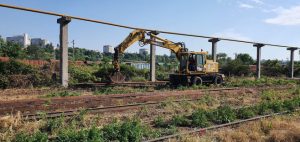
Bulgaria investește acum, cu termene de realizare scurte si fezabile, în calea ferată din porturile Burgas și Varna. România are porturi mai mari și mai adânci, dar calea ferată din Portul Constanța se modernizează în etape cu durate contractuale de peste 13 ani. Dacă ritmul nu se schimbă, mărfurile în tranzit pot ocoli porturile românești, deși Constanța este mai bine poziționată. Ce face Bulgaria Punctual: Nu sunt proiecte spectaculoase. Sunt proiecte mici, rapide, finanțate și legate de o strategie de coridor. Exact asta lipsește la noi. Ce are România Avantajul fizic al României este real: Nave mari ar veni la Constanța. Problema începe când marfa trebuie să plece din port. Unde pierdem: calea ferată din port Datele publice sunt cunoscute de ani de zile: De ce contează acum Ce ar trebui făcut Concluzie România nu are o problemă de geografie. Are o problemă de ritm. Bulgaria a înțeles că portul se câștigă pe ultimii kilometri de cale ferată. Convingerea mea este că, dacă nu tratăm calea ferată portuară cu aceeași urgență, vom avea cel mai adânc port de la vestul Mării Negre și mărfuri care trec pe lângă el.
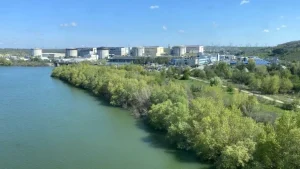
In short EUR values converted at RON 5.2/EUR, rounded. Indicative only. This is a pipeline signal, not a tender notice. For hydrotechnical and river-works contractors, it is the moment to decide whether to prepare for the third procedure, and with whom. 1. What the Bala 2 project is The Bala branch is where the Danube splits near Cernavoda. Over the years, more water has flowed through Bala and less through the Old Danube (Dunarea Veche), the arm that serves navigation and the cooling water intake of the Cernavoda nuclear power plant. Bala 1, executed under a 2009 FIDIC Red Book contract and received in 2016, was meant to correct this with a bottom sill. After objections from environmental organisations, the sill was built at a lower elevation than designed, and the effect was limited. This is the account given by AFDJ Galati in its public chronology. Bala 2 is the follow-up: “restoration and renaturalisation of the Bala bifurcation zone for navigation conditions and environmental protection”. According to AFDJ, nine technical alternatives were assessed, and the chosen solution was modelled in 2D, 3D hydrodynamic and quasi-3D morphodynamic simulations over a 50-year horizon. The expected effects, as published in the approved indicators: Indicator Value Flow increase towards the Old Danube approx. 168% Water level rise up to 1.20 m Current velocity increase approx. 0.3–0.5 m/s Cooling water availability for the four Cernavoda reactors over 97% The nuclear angle is what moved the project back up the agenda. In summer 2026 low Danube flows affected the plant’s operation, Romania entered an energy alert, and on 31 July the Government asked the Ministry of Transport to put Bala 2 back on the priority list. 2. What happened between August and September 2026 Economedia published on 2 October 2026, citing AFDJ Galati, the following sequence: Date Step 11 Aug AFDJ, Ministry of Transport and EIB PASSA discuss accelerating implementation 14 Aug Interministerial Committee BALA set up by Prime Minister’s decision: technical solutions, updated indicators, implementation calendar, financing sources 2 Sept AFDJ, CNE Cernavoda, SNN and EnergoNuclear discuss data for updating the 2D/3D hydrodynamic model 7 Sept Project Implementation Unit requests a meeting on the tender documentation (caiet de sarcini), to prepare restarting the design-and-build procedure 14 Sept AFDJ and the Ministry review the updated tender documentation, including changes on site: four stone-laden barges sunk and the Parjoia rock detonated 15 Sept Order signed for revision of the general estimate (deviz general) 18 Sept Draft tender documentation sent to the Ministry 22 Sept Revised general estimate received by AFDJ 28 Sept Updated indicators approved by AFDJ’s Technical-Economic Council AFDJ’s statement on what follows: approval in the Ministry’s CTE, then the budget line, then the tender for design and execution. No dates were given. 3. Why the two previous tenders failed, and why that matters now AFDJ’s own chronology, as reported by Mediafax, gives two data points that bidders should weigh: Two readings follow. First, the market did not see this as an attractive contract at the 2023 price level and a 60-month duration: a complex river-works job with environmental constraints, a single prime contract, and a history of NGO challenges. Second, the authority had never secured the money before tendering. What is different in the third attempt is the financing pressure, not the technical scope. The Interministerial Committee has financing on its mandate, the EIB’s PASSA advisory unit is in the room, and the project now carries an energy-security justification that it did not have in 2024. Whether this converts into a budget line before the notice is published is the question to watch. We have no information on that. 4. What the tender is likely to look like Caution: the documentation has not been published. What follows is based on the previous procedures and the approved indicators, and must be checked against the notice when it appears. 5. What foreign bidders should do now M Infra Design & Management supports international contractors and engineering groups with tender management, design coordination and construction supervision on Romanian public contracts, including port and waterway infrastructure.

On 30.09.2026 we attended, together with the management of Mangalia Shipyard (Șantierul Naval Mangalia S.A.), the CMA Black Sea Stakeholder Conference 2026 in Burgas, Bulgaria. The conference is the annual forum of the Common Maritime Agenda for the Black Sea (CMA), a sea-basin initiative supported by the European Commission. Bulgaria coordinates the CMA in 2026, taking over from Ukraine. The event was opened by Bulgarian Deputy Minister of Agriculture and Food Ivan Paligorov and by Charlina Vitcheva, Director-General of DG MARE. We were informed first-hand of the projects and priorities the European Commission, through DG MARE, will follow in the region. The Agenda pursues three goals: healthy marine and coastal ecosystems, a competitive and sustainable blue economy, and investment in the Black Sea blue economy. We were glad to see the CMA participating countries – Bulgaria, Georgia, the Republic of Moldova, Romania, Türkiye and Ukraine – at the same table. A Black Sea united through cooperation is the natural framework for the development of the Romanian shipbuilding industry. For SN Mangalia, this means direct access to European priorities and to a network of partners across the Black Sea basin. For M Infra, it means preparing early for the funding opportunities and tenders that will follow from these priorities.
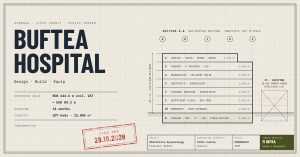
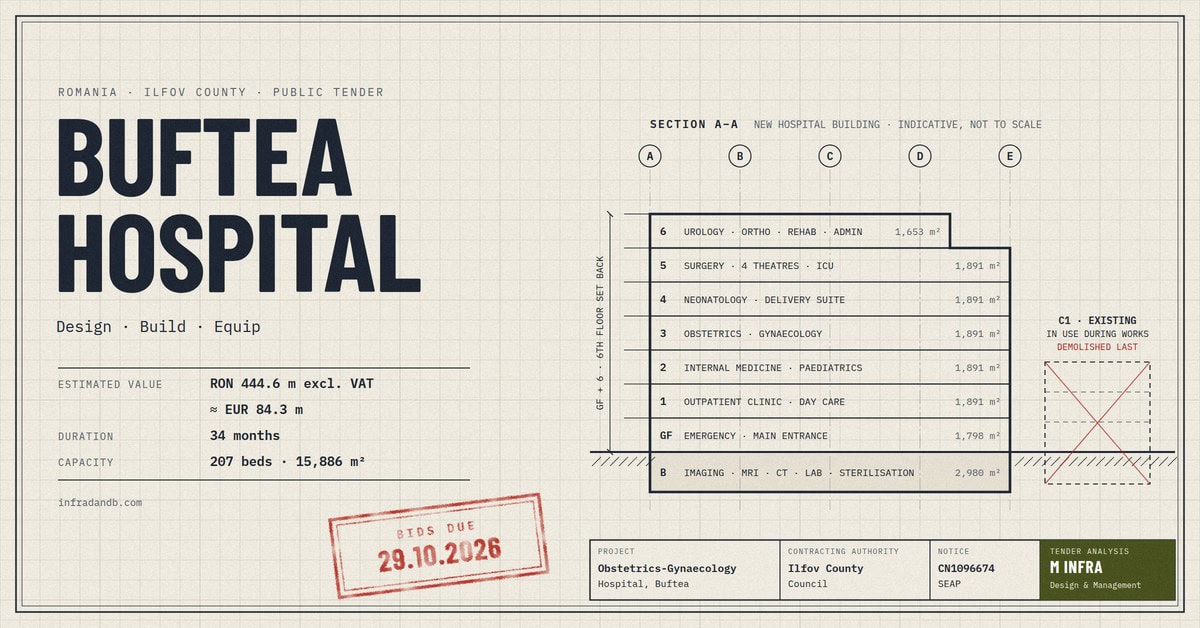
The Buftea hospital tender is now open on SEAP, the Romanian public procurement platform. Ilfov County Council wants one contractor to design, build and equip a new obstetrics and gynaecology hospital. The site is in Buftea, just north of Bucharest. The estimated value is RON 444.6 million excluding VAT, about EUR 84.3 million. Bids are due on 29.10.2026. This article sets out the key facts for international contractors, designers and medical equipment suppliers. It also explains where a local partner adds value. Buftea hospital tender at a glance Notice number CN1096674 (SEAP) Contracting authority Ilfov County – Ilfov County Council Procedure Open procedure, Law 98/2016 Contract type Works – design and build, including equipment Estimated value RON 444,591,972.60 excl. VAT (≈ EUR 84.3 million*) Duration 34 months: 6 months design + 28 months works, equipment and commissioning Award criterion Best price-quality ratio (price 40%, technical factors 60%) Clarification requests Up to 20 days before the deadline Bid deadline 29.10.2026 Funding PNIIUS national hospital programme; project first approved under Romania’s Recovery and Resilience Plan *Indicative, at the NBR rate of RON 5.2718/EUR published on 25.09.2026. What the project includes The hospital currently runs in old pavilions. The county will replace them with one modern building. The existing hospital stays open during the works, so phasing is central to the contract. Where the value sits The approved general budget (Ilfov County Council Decision 260/27.11.2025) shows an unusual split. Equipment matters more than construction here. Component RON million excl. VAT Share Medical equipment and furnishings 213.50 48.0% Construction and installation works 165.60 37.2% Plant and equipment with installation 55.00 12.4% Design 6.36 1.4% Other (site organisation, designer’s assistance, energy certificate) 4.13 0.9% Our breakdown of the estimated value, based on the approved general budget. In practice, a winning team needs a strong medical equipment supplier as well as a contractor. The supplier must hold a valid ANMDMR operating licence at the bid deadline. Key qualification requirements Joint ventures, third-party support and subcontracting are allowed. Foreign companies may use equivalent documents from their home country. All documents need a Romanian translation. How the bids will be scored In the Buftea hospital tender, price carries 40 points. The remaining 60 points reward quality. The implementation plan alone is worth 21 points. Each of four key experts can earn up to 6 points for extra hospital projects. The works warranty is worth 10 points, and the warranty on key imaging equipment is worth 5 points. As a result, a low price alone will not win. A detailed, site-specific methodology is just as important. So are the right experts. How M Infra supports bidders M Infra Design & Management works with international contractors on Romanian public tenders. We have supported hospital bids of this type before. For the Buftea hospital tender, we offer: Time is short. Clarification requests close 20 days before the bid deadline. Contact M Infra to discuss your participation in the Buftea hospital tender.
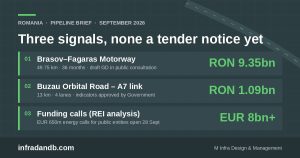
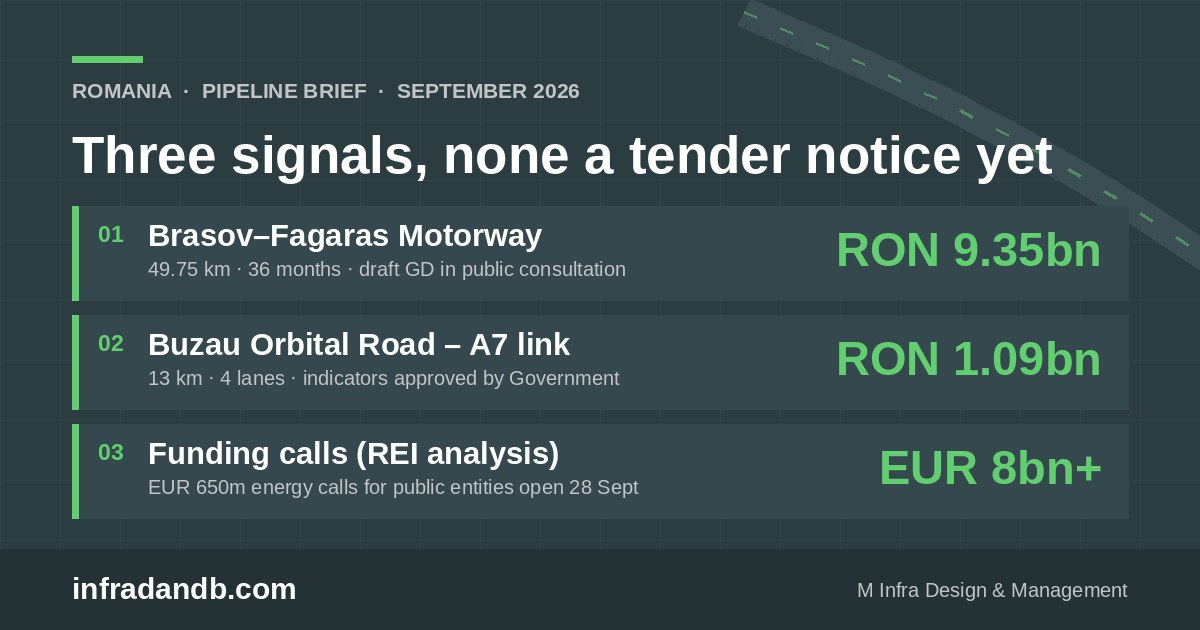
In short EUR values converted at RON 5.2/EUR, rounded. Indicative only. None of these three items is a contract notice. They are the stage before it, which is when consortium, qualification and resourcing decisions are still cheap to make. 1. Buzau Orbital Road: indicators approved, works tender not yet announced The Romanian Government has approved the technical-economic indicators for “Drum Orbital – Legătura A7 – Buzău (Tronsoanele 2, 3 și 4)”, as reported by a Government press release. What is known: What is not known from the published information: the value excluding VAT, the construction-and-assembly (C+M) component, the procurement method (build-only or design-and-build), lotting, and any launch date. We have not seen the Government decision number or the annex with the indicators. Those are the documents to obtain before drawing conclusions on qualification thresholds. Why it matters: approval of indicators is the formal precondition for launching the works procedure. For a project financed under a 2021–2027 programme, the eligibility calendar puts pressure on the contracting authority to move quickly. This is our reading, not an announced schedule. 2. Brasov–Fagaras Motorway: RON 9.35bn, one step before Government approval The Ministry of Transport and Infrastructure has placed in public consultation the draft Government decision approving the indicators for the Brasov–Fagaras Motorway, as reported by Bună Ziua Brașov and Economedia on 18 September 2026. Figures from the draft decision, as reported: Indicator Value Total investment value RON 9,351,780,000 incl. VAT (approx. EUR 1.8bn) Length 49.75 km Platform width 26 m Execution period 36 months Bridges, passages, viaducts 46 Tunnel-type structures (cut-and-cover / canopy) 6, including wildlife crossings Interchanges 1, at Șercaia (connection with DN 1 and DN 1S) Other One pair of service areas, one pair of parking areas, one maintenance and coordination centre (Șercaia) Land take 663 ha, public and private Territories crossed Codlea, Dumbrăvița, Șercaia, Șinca, Mândra Financing is indicated as the Transport Programme 2021–2027 and the state budget, plus other sources if identified. Two points bidders should note: The draft still has to complete public consultation and be adopted. Values can change between the draft and the adopted decision. 3. EUR 8bn in funding calls: read them as next year’s tender pipeline An analysis by REI Grup, published by Economedia on 14 September 2026, puts the funding available to companies and public authorities at over EUR 8bn: roughly EUR 4bn through calls already open or about to open this autumn, and a further EUR 4bn through state-aid schemes under Romania’s economic relaunch framework. According to the analysis, most of these calls were originally planned for the summer and were rescheduled to the autumn. For contractors and engineering firms, the relevant part is not the grant itself but what follows it: a public beneficiary that secures financing must then procure design, works and supervision under Law 98/2016. Calls with a direct procurement consequence, as listed in the analysis: Programme Budget Eligible applicants Window New solar generation capacity with integrated storage, for self-consumption EUR 500m Municipalities, publicly funded hospitals, penitentiary units, public institutions 28 Sep – 20 Nov 2026, first-come, until budget exhausted New storage capacity for renewable electricity EUR 150m Municipalities, defence and public-order units, hospitals, public institutions 28 Sep – 20 Nov 2026, first-come, until budget exhausted Stand-alone storage (Modernisation Fund) EUR 150m Companies active in electricity production and supply 1 Sep – 31 Oct 2026 National Programme for Consolidation of High Seismic Risk Buildings EUR 1bn (2026) Pre-1978 buildings: schools, medical units, residential blocks Audit and expertise first, technical design after approval Sewerage and public lighting (Environment Fund Administration) EUR 500m Municipalities Not stated e-MOBILITY RO: charging infrastructure on motorways, expressways and TEN-T national roads administered by CNAIR EUR 299m Micro, SME and large enterprises (no start-ups) Call expected Sep–Oct 2026 Zero-emission equipment for naval and air transport, port operators included EUR 299m Port operators, air transport companies, ancillary transport services Call expected Q4 2026 Just Transition Programme: energy renovation of multi-family residential buildings EUR 160m Municipalities 19 Aug 2026 – 3 Feb 2027 A caution on the source. This is a consultancy’s market overview, not an official calendar. Some figures in it do not reconcile (for example, the sub-measure allocations quoted for one e-mobility scheme add up to more than the stated total budget), and three separate schemes are listed with an identical EUR 299m budget. Check every budget and date against the applicant guide issued by the managing authority before acting on it. What this means in practice. First-come, first-served calls closing on 20 November produce financing contracts over the following months, and procurement procedures after that. For EPC contractors, storage integrators and supervision firms, the sensible moment to identify local partners and check the similar-experience requirements typical of municipal tenders is now, not at notice publication. What foreign bidders should do this month M Infra Design & Management supports international contractors and engineering groups with tender management, design coordination and construction supervision on Romanian public contracts.