Contracting authority: Sector 1 of the Municipality of Bucharest | Reference: 4505359_2026_PAAPD1614338 | Corrigendum published in the EU Official Journal, 2 September 2026
Sector 1 of Bucharest has tendered the design and construction of Object no. 2 of the “PROMENADA VERDE” investment objective — the renovation, rehabilitation and consolidation of the banks of Lake Grivița.
The notice examined here is a corrigendum, not the original contract notice. It was transmitted on 1 September 2026 and published the following day. Its stated reason is “update-add — information update”, and it changes three things:
- The deadline for receipt of tenders
- The date until which offers must remain valid
- The tender opening date
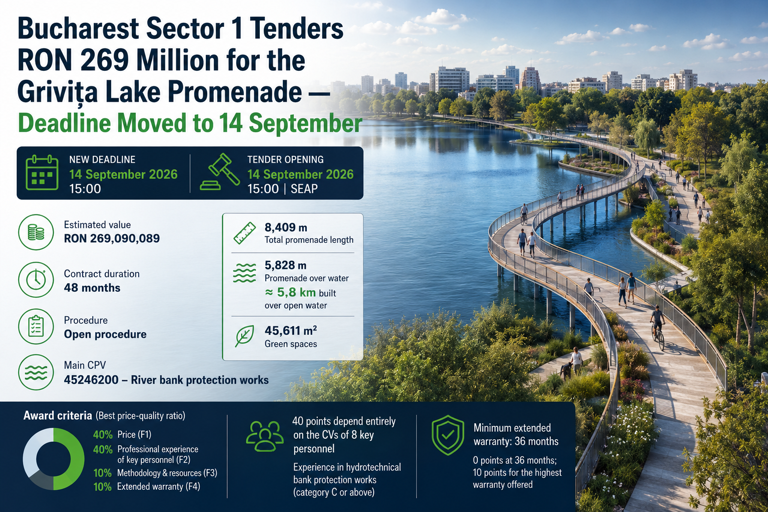
The submission deadline is now 14 September 2026 at 15:00, with tender opening the same day at the same hour, in SEAP, before the members of the evaluation committee.
If you were working to an earlier date, that date is superseded. And a corrigendum that moves a deadline forward compresses whatever preparation time remained — worth checking against your own calendar immediately.
Scope and value
The contract covers design services (technical design and execution details), technical quality verification of the design, technical assistance during execution, and the construction works themselves. It is an open procedure with a duration of 48 months.
Estimated value: RON 269,090,089.
Main CPV code: 45246200 – River bank protection works. The full CPV set is unusually broad, spanning hydrotechnical works, bridge and footbridge construction, road works, electrical installations, utility networks, landscaping and planting, and design services — which tells you something about the range of capability required.
The physical indicators
The approved performance indicators, drawn from the feasibility study under Article 7 of Government Decision 907/2016:
| Indicator | Quantity |
|---|---|
| Total intervention area | 867,885.52 m² |
| — Water surface | 764,618.12 m² |
| — Green spaces | 45,611.40 m² |
| — Total promenade area (on ground and over water) | 57,656.00 m² |
| Total promenade length | 8,409.00 m |
| — Pedestrian footbridges | 231 m |
| — Promenade on ground | 2,350.00 m |
| — Promenade over water | 5,828.00 m |
Roughly 5.8 kilometres of the promenade is built over open water. That single figure defines the technical character of this contract more than any other.
The stated condition of the existing bank defences is degradation, in places severely advanced, caused by environmental action — precipitation, groundwater circulation, freeze-thaw cycling, meteoric water — compounded by the absence of regular maintenance across the structure’s service life.
The scoring grid: personnel experience carries 40 points
Award is on best price-quality ratio, with total score calculated as F1 + F2 + F3 + F4:
| Factor | Weight |
|---|---|
| F1 — Offer price | 40 |
| F2 — Professional experience of key personnel (sum of 8 sub-factors) | 40 |
| F2.1 — Contract Manager / Coordinator | 5 |
| F2.2 — Hydrotechnical construction and works design engineer (design team coordinator) | 5 |
| F2.3 — Architect | 5 |
| F2.4 — Railways, roads and bridges structural design engineer | 5 |
| F2.5 — Building structural design engineer | 5 |
| F2.6 — Utility networks design engineer | 5 |
| F2.7 — Electrical installations design engineer | 5 |
| F2.8 — Site manager / works manager | 5 |
| F3 — Methodology and resource planning | 10 |
| F4 — Extended warranty period | 10 |
| Total | 100 |
This distribution is the defining feature of the procedure. Forty points — the same weight as price — depend entirely on the CVs of eight named individuals.
Sub-factor F2.1 illustrates the pattern: points are awarded for having held the position of Contract Manager, Coordinator or Technical Director on contracts involving execution and/or design-and-build works falling within the category of hydrotechnical works for bank stabilisation, rehabilitation and protection, and promenades, executed to importance category C or above under Government Decision 766/1997. A minimum of 3 such contracts scores 2 points, 4 contracts scores 3, and so on up the scale.
The specificity is the point. This is not “a bridge engineer” — it is a design engineer with documented hydrotechnical bank-protection experience at category C. Multiply that across eight positions and the practical question becomes whether you can assemble and evidence the full team, not whether you can build the works.
F4 — extended warranty: the minimum accepted is 36 months. Below that, non-compliant. At exactly 36 months, zero points. The highest warranty offered scores 10, with others proportional: P2(n) = (Gn / Gmax) × 10.
Qualification requirements
Turnover. Average annual turnover over 2023, 2024 and 2025 of at least RON 200,000,000, or the equivalent in another currency at the BNR average rate for the relevant year. In a joint bid, this may be met cumulatively by the members of the consortium.
Similar experience — works. Works completed in the last 5 years on construction, consolidation, modernisation, rehabilitation or extension of structures of importance category C or higher under Government Decision 766/1997, across a maximum of 8 contracts, with a cumulative value of at least RON 200,000,000.
Critically, at least one of those contracts must fall within the category of hydrotechnical works serving reservoir, recreational and/or tourist lakes.
Similar experience — design. Design services completed in the last 5 years for the same category of structures, across a maximum of 3 contracts, cumulative value at least RON 3,000,000 — again with at least one contract in the hydrotechnical lake category.
That single mandatory reference, on both the works and the design side, is the narrowest gate in the procedure. RON 200 million of general category C construction is achievable for many contractors. One documented lake-related hydrotechnical contract is not.
Plant and equipment. The required fleet is specific and revealing:
- Large-capacity motor pumps — 4
- Reversible plate compactors / rammers — 3
- Mobile concrete mixers — 2
- Telescopic handler — 1; Backhoe loader — 1; Front loaders — 2
- Street tipper trucks 8×4, 20 t+ — 2
- Small tandem roller, 2–3 t — 1
- Long-reach tracked excavator — 1
- Heavy tracked excavator (30–40 t) with wide tracks and hydraulic attachment system, minimum equipment: 1 sheet-pile vibratory driver, 1 hydraulic breaker, 1 excavation bucket rated to the machine class — 1
- Rotary pile drilling rig (Kelly drilling, Ø800 mm) — 1
- Articulated site dumper 6×6 — 2
- Tracked bulldozer — 1
- Earthworks roller over 12 t, vibratory/padfoot — 1
The sheet-pile driver, the long-reach excavator, the Ø800 mm piling rig and four large motor pumps are not general civil works equipment. They describe working at and below a waterline. Access may be through ownership, rental, loan-for-use, leasing or service contract, and in a consortium the requirement is met by pooling members’ resources.
What the equipment list tells you that the scope statement does not
Read the fleet requirement alongside the 5,828 metres of promenade over water and the picture resolves: this is a piling contract with a landscaping programme attached, not a park refurbishment with some waterfront.
Sheet piling, Ø800 mm bored piles, long-reach excavation and heavy dewatering capacity are the core of the works. The green spaces, the planting, the electrical installations and the utility networks are real, but they are not what will determine whether the contract is deliverable.
For a foreign contractor assessing fit, the honest test is not “can we build promenades” but “have we driven sheet piles and bored piles into a lakebed, and can we evidence it in a contract that a Romanian evaluation committee will accept.”
Subcontracting and consortium structure
Subcontractors must be named in the offer with the parts and percentages allocated, and subcontracting agreements uploaded to SEAP with the DUAE and the offer, signed with qualified electronic signatures. Agreements must state the subcontractor’s identification data, the activities subcontracted, the percentage or value, and any option for direct payment.
Subcontractors whose capacity the bidder relies on for qualification complete a full DUAE. Those whose capacity is not relied upon complete a DUAE solely to demonstrate they fall outside the exclusion grounds of Articles 164, 165 and 167.
Third-party support is available for economic and financial capacity under Article 182, with a firm commitment and supporting documents showing how the support will actually be delivered.
Given the turnover threshold, the eight scored personnel positions, and the mandatory hydrotechnical reference, a consortium is the realistic route for most bidders. All three requirements can be met by pooling — but the pooling has to be documented and submitted with the offer, not arranged afterwards.
Contested points and remedies
Challenges go to the National Council for Solving Complaints (CNSC), Str. Stavropoleos nr. 6, Bucharest, within the time limits of Article 8 of Law 101/2016.
The strategic read
The deadline moved. Verify it. This is a corrigendum, and the new date is 14 September 2026, 15:00. With opening the same hour, there is no grace period.
Forty points sit in eight CVs. A bidder with excellent construction capability and an incomplete design team will lose to one with adequate capability and a fully evidenced team. The personnel dossier is not administrative overhead in this procedure — it is half the technical score and equal in weight to price.
One reference decides eligibility. The mandatory hydrotechnical lake contract, required separately on both the works and design sides, is the binding constraint. Before committing resources to anything else, establish whether you hold it or need a partner who does.
Forty-eight months is a long exposure. Design, verification, technical assistance and execution across four years, on a structure being built over water, with the ground risk that implies. The warranty factor starts at 36 months from acceptance, which extends the tail further.