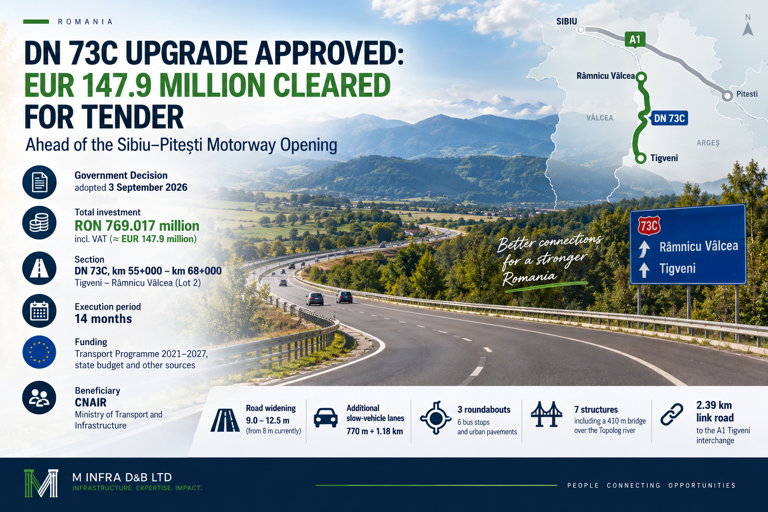
Government Decision adopted Thursday, 3 September 2026
The Romanian Government has approved the technical-economic indicators for the rehabilitation and modernisation of DN 73C between Tigveni and Râmnicu Vâlcea, clearing the final administrative step before CNAIR can launch the works tender.
The official designation in the Government Decision is “Rehabilitation/modernisation of DN 73C, km 55+000 – km 68+000, Tigveni – Municipality of Râmnicu Vâlcea (Lot 2)”, covering Argeș and Vâlcea counties. In infrastructure press it is commonly referred to as “Lot 6” of the Sibiu–Pitești motorway, though the works are not a motorway section in the strict sense.
Total investment: RON 769.017 million including VAT, at March 2025 prices.
The figures in euro
Converted at the rate you asked me to apply, 5.2 RON = 1 EUR:
| Item | RON (incl. VAT) | EUR (approx.) |
|---|---|---|
| Total investment | 769,017,000 | 147.9 million |
| Construction and assembly works (C+M) | 652,006,000 | 125.4 million |
| Year 1 — total | 500,000,000 | 96.2 million |
| Year 1 — C+M | 400,000,000 | 76.9 million |
| Year 2 — total | 269,017,000 | 51.7 million |
| Year 2 — C+M | 252,006,000 | 48.5 million |
Two cautions on these numbers. First, 5.2 is a working conversion rate, not the official BNR rate — for any bid calculation, use the rate specified in the tender documentation, which will normally be the BNR rate at a defined reference date. Second, and more importantly for pricing: all figures above include VAT. Romanian tender values are published exclusive of VAT, so the contract value that eventually appears in SEAP will be materially lower than RON 769 million.
Beneficiary: CNAIR (National Company for Road Infrastructure Administration). Principal credit officer: Ministry of Transport and Infrastructure. Execution period: 14 months.
Funding: non-reimbursable external funds through the Transport Programme 2021–2027, the state budget via the Ministry of Transport, and other legally constituted sources. The project sits under Priority 2 of the Transport Programme, covering improvement of secondary road connectivity.
Why this road, and why now
DN 73C is currently a degraded national road with an 8-metre platform: a 6-metre carriageway and two 1-metre shoulders.
The driver is the A1 Sibiu–Pitești motorway. When the Curtea de Argeș – Tigveni section — built by the Austrian contractor PORR — opens to traffic, vehicles arriving at the Tigveni interchange will need an adequate road connection towards Râmnicu Vâlcea. The justification note frames this as ensuring the absorption and smooth flow of a share of the major road traffic that will shift onto this section once the Sibiu–Pitești corridor develops.
In other words, this is not a standalone road upgrade. It is the piece that makes a motorway opening functional.
Scope of works
The national road
The DN 73C platform will be widened from 8 metres to between 9.00 and 12.50 metres, with two 3.5-metre traffic lanes, edge strips and shoulders.
On two sections where the traffic study found heavy vehicles exceeding 20% and gradients of at least 4%, additional slow-vehicle lanes will be built — one of 770 metres, the other of 1.18 kilometres. On those stretches the road will carry three lanes.
Also included: three roundabouts (at the DN 73C junction with DJ 678A near Ciofrângeni, at the junction with DN 7, and where the link road meets DJ 678A and DC 239), six bus stops, and pavements through built-up areas.
Drainage works comprise 35 P2-type culverts and seven D5-type culverts on DN 73C, plus a further four on the link road.
The new 2.39 km link road
A new 2.39-kilometre link road will connect DN 73C to the A1 at the Tigveni interchange. The alignment was selected after two stages of multi-criteria analysis, with the objective of discharging motorway traffic into DN 73C without routing transit traffic through the built-up area of Tigveni. Roughly 600 metres of DJ 678A will also be rehabilitated to complete the connection.
The link road platform is substantially wider at 19.5 metres, with two lanes in each direction and a median. Lighting is specified for the roundabouts, for both bridges over the Topolog river, and for the parking area at km 55+600.
Seven structures, including a 410-metre bridge
The project includes seven engineering structures: two existing DN 73C bridges rehabilitated, two underpasses and two bridges built on the link road, and the existing DJ 678A bridge replaced.
The principal structure is a new 410-metre bridge over the Topolog river on the link road, with eight spans, carrying four traffic lanes — two in each direction — plus two footways.
A second new Topolog crossing at km 2+245 will be 170.5 metres long with three spans.
The rehabilitation works cover the existing DN 73C bridges over the Bădislava and Sâmnic rivers, and replacement of a DJ 678A bridge described as severely degraded.
Land acquisition
Total land occupation required: 302,037 square metres, of which approximately 210,760 m² are estimated as requiring expropriation.
Works will run across both public and private land, in Argeș and Vâlcea counties, within and outside the built-up areas of the Tigveni, Ciofrângeni and Golești administrative units.
What this means commercially
A tender is now the next step. The Government Decision on technical-economic indicators is the administrative gate that precedes procurement. With it adopted, CNAIR can launch the acquisition procedure for the works.
I would not put a date on that launch. The interval between indicator approval and notice publication varies substantially between CNAIR projects and depends on factors not visible from outside. Anyone quoting you a firm timeline is estimating.
The 14-month execution period is short for this scope. Thirteen and a half kilometres of national road widening, a 2.39 km dual-carriageway link road, seven structures including a 410-metre eight-span bridge, three roundabouts, and 46 culverts — in 14 months. Read alongside the two-year financial phasing, with RON 400 million of C+M in year one, the implied production rate is demanding. That has direct consequences for plant mobilisation, for the number of simultaneous work fronts, and for how a bidder builds a credible programme.
The bridge is the critical path. A 410-metre, eight-span crossing of the Topolog is the single element most likely to determine whether 14 months is achievable. Any bidder assessing this contract should model that structure first and the road works second.
Expropriation of 210,760 m² is a real schedule risk. Land acquisition running in parallel with a 14-month programme, across two counties and three administrative units, on both public and private land, is a familiar source of delay on Romanian road projects. Whether it is priced as contractor risk or authority risk will be one of the more consequential clauses in the eventual contract.
The corridor context matters for what comes next. This is one piece of a wider programme. CNAIR received eight bids for the design-and-build tender on the adjacent Curtea de Argeș – Tigveni section — a useful indication of the level of competition this corridor attracts. Further sections of the Sibiu–Pitești corridor remain in progress, including Cornetu – Tigveni, so the pipeline in this geography does not end with DN 73C.