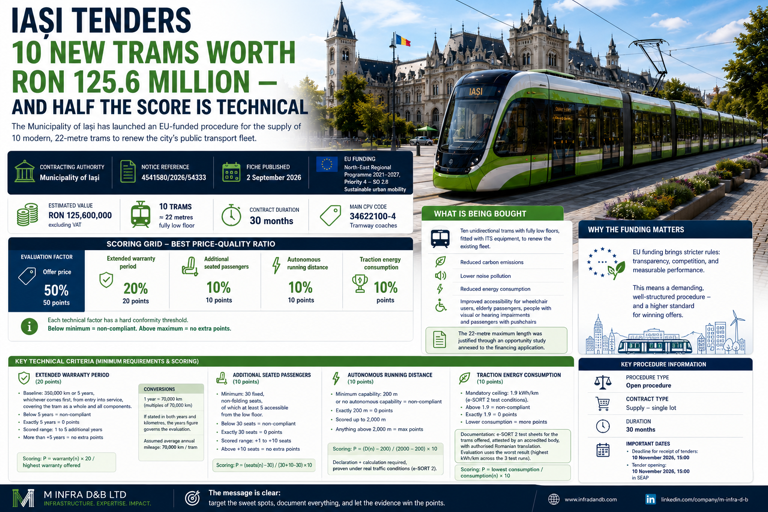
Contracting authority: Municipality of Iași | Notice reference: 4541580/2026/54333 | Fiche published 2 September 2026
The Municipality of Iași has opened an EU-funded procedure for the supply of 10 new trams of approximately 22 metres, under the project “Purchase of new trams – Purchase of public transport vehicles – 22 m trams for the Municipality of Iași”, SMIS code 354270.
This is a supply contract, single lot, with a duration of 30 months. Main CPV code: 34622100-4 – Tramway coaches.
Estimated value: RON 125,600,000 excluding VAT.
Unlike most Romanian infrastructure procedures, this one is financed from EU funds — through the North-East Regional Programme 2021–2027, Priority 4 (a more sustainable urban mobility region), Specific Objective 2.8 on sustainable multimodal urban mobility. That funding source matters, and I return to it at the end.
What is being bought
Ten unidirectional trams with fully low floors, fitted with ITS equipment, intended to renew the existing fleet. The stated rationale runs through reduced carbon emissions, lower noise pollution, reduced energy consumption, and improved accessibility for wheelchair users, elderly passengers, people with visual or hearing impairments, and passengers with pushchairs.
The 22-metre maximum length was justified through an opportunity study annexed to the financing application.
The scoring grid: price is half, but the other half is where offers are won and lost
Award is on best price-quality ratio:
| Evaluation factor | Weight | Max points |
|---|---|---|
| Offer price | 50% | 50 |
| Extended warranty period | 20% | 20 |
| Additional seated passengers | 10% | 10 |
| Autonomous running distance | 10% | 10 |
| Traction energy consumption | 10% | 10 |
| Total | 100 |
Price is scored proportionally: P(n) = (lowest price offered / price n) × 50.
At 50%, price carries more weight here than in most Romanian works procedures. But the four technical factors are unusual in a specific way: each has a hard conformity threshold beneath which the offer is rejected outright, and a ceiling above which extra performance earns nothing.
That structure rewards precise targeting rather than maximum specification. Overshooting costs money and earns zero additional points.
Extended warranty — 20 points, the largest technical factor
The baseline required by the terms of reference is 350,000 km or 5 years, whichever comes first, from entry into service, covering the tram as a whole and all its components.
- An offer with a warranty below 5 years is non-compliant
- An offer at exactly 5 years scores zero points
- The scored range is 1 to 5 additional years beyond the mandatory period
- More than 5 additional years earns no further points
Scoring is proportional: Pwarranty(n) = warranty(n) × 20 / highest warranty offered.
Two conversion rules matter here. Warranties expressed in kilometres convert at 1 year = 70,000 km, and must be offered in multiples of 70,000 km. Where a warranty is stated in both years and kilometres, the years figure governs the evaluation. The bidder must also calculate on an assumed average annual mileage of 70,000 km per tram.
Traction energy consumption — 10 points, and a documentary trap
The mandatory ceiling is 1.9 kWh/km under e-SORT 2 test conditions. Above that, the offer is rejected. At exactly 1.9 kWh/km, zero points.
Scoring: P(n) = (lowest consumption offered / consumption n) × 10.
The documentary requirement is where this factor gets demanding. The offer must contain e-SORT 2 test sheets for the trams offered, attested by an accredited body, with authorised Romanian translation. And the value used for evaluation is not the average of the three SORT 2 cycle tests — it is the worst result, the highest kWh/km recorded across the three runs.
For a manufacturer whose test documentation shows a favourable average but a variable spread, this rule alone can cost points.
Autonomous running distance — 10 points
The tram must be capable of running independently of the overhead contact network. Below 200 m, or with no autonomous capability at all, the offer is non-compliant. At exactly 200 m, zero points. The formula:
P(offer) = (D(offer) − 200) / (2000 − 200) × 10
Anything beyond 2,000 m still scores 10 points — so 2,000 m is the efficient target, not the maximum the vehicle can technically achieve.
The bidder must submit a declaration accompanied by a calculation demonstrating that the onboard energy unit actually supports the offered distance under real traffic conditions (e-SORT 2), not under theoretical conditions.
Additional seated passengers — 10 points
Minimum capacity is 30 fixed, non-folding seats, of which at least 5 accessible from the low floor. Below 30 seats, the offer is non-compliant. At exactly 30, zero points. The scored range is 1 to 10 additional seats; beyond 10, no further points.
Additional seating must still respect minimum total passenger capacity, minimum standing capacity, minimum seat pitch, and UNECE R 107.
Qualification requirements: notably light
This is the part that will surprise contractors used to Romanian works procedures.
Similar experience: supply of similar products in a cumulative value of at least RON 125,000,000 excluding VAT over the last 3 years, across one or more contracts. Similar products are defined as a rail-guided road vehicle intended for transport, or products of the same nature and complexity, or superior.
Economic and financial capacity: the fiche contains no turnover requirement and no liquidity ratio. Section III.1.2 is present but sets no threshold.
Quality and environmental standards: Section III.1.3.b is empty. No ISO 9001 or ISO 14001 requirement.
Personnel: no named specialists required. Section III.2.3 confirms the obligation to state employee names and qualifications does not apply.
Compared to the works procedures running in Romania at similar values — which routinely demand turnover of one and a half to two times contract value, liquidity ratios tested year by year, and dedicated cash flow — the qualification burden here is light. The filter in this procedure is not financial standing. It is whether you manufacture a compliant tram and can document it.
Guarantees and administrative terms
- Tender guarantee: RON 1,256,000 (1%), valid at least as long as the offer, i.e. 4 months from the submission deadline. Account: RO45TREZ4065006XXX000460, Trezoreria Municipiului Iași, CIF 4541580.
- Performance guarantee: 10% of contract value excluding VAT, constituted within 5 working days of signature (extendable to 15 days on justified request). May be constituted through successive withholdings from partial invoices, with an initial deposit of at least 0.5%.
- Offer validity: 4 months from the deadline for receipt of tenders.
- Language: Romanian, or accompanied by authorised Romanian translation.
- Procedure: open, entirely online through SEAP, with qualified electronic signatures throughout.
- Alternative offers: not accepted.
Clarification requests may be submitted up to 18 days before the submission deadline; the authority will respond on the 11th day before it.
The submission deadline is not stated in the fiche itself. It appears in the contract notice in SEAP. Anyone working to this procedure should take the date from there rather than from any secondary source, including this article.
Price adjustment
Adjustment applies only from the 24th month after the delivery commencement order, using the total consumer price index published by the National Institute of Statistics: C(A) = IPC/100, applied to the contractual unit price.
For a 30-month contract, that means the first 23 months carry no indexation. Bidders pricing a component supply chain across nearly two years of fixed pricing should build that exposure into the offer rather than assume adjustment will absorb it.
Where an advance is granted, no adjustment applies to the value covered and recovered by that advance.
Tie-breaking
If two or more offers tie on total score, the tie is broken by the score obtained on the evaluation factors in descending order of their weight — so extended warranty first, then the three 10% factors. If equality persists, the authority requests new financial proposals and the lowest price wins.
That rule has a practical consequence: the extended warranty factor is not only the largest technical factor, it is also the first tie-breaker. It deserves more attention than its 20 points alone would suggest.
The strategic read
Three things distinguish this procedure.
The qualification threshold is low relative to the contract value. RON 125 million of similar supply over three years is a real requirement, but it is roughly one contract’s worth of trams for any established European manufacturer. There is no turnover test, no liquidity test, no ISO requirement. This procedure is open to a wider field than its value would suggest.
The technical factors have ceilings, and the ceilings are the target. 2,000 m of autonomous running. 10 additional seats. 5 additional warranty years. Exceeding any of these earns nothing while costing something. The optimisation problem is hitting each ceiling at the lowest cost, not maximising each parameter.
The documentation determines the score, not the vehicle. Accredited e-SORT 2 test sheets with authorised translation. A calculation substantiating autonomous range under real traffic conditions. The worst of three test runs, not the average. A manufacturer with a strong product and weak test documentation will lose to one with a comparable product and complete documentation.
The EU funding source adds one further consideration. Regional Programme contracts carry absorption deadlines, which in practice means the authority has an institutional interest in a procedure that concludes without challenge. That cuts both ways for a bidder: it raises the cost of a frivolous challenge, and it raises the value of an offer that is clearly, documentably compliant on first reading.