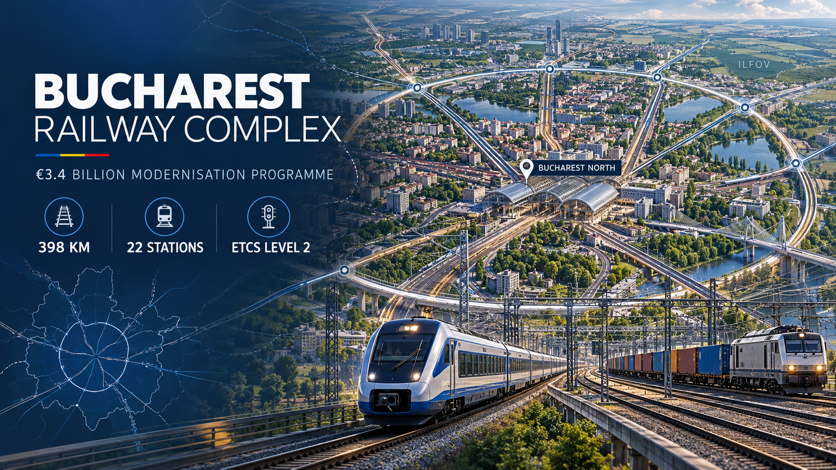
On 9 October 2026, the Romanian Government approved the technical and economic indicators for the modernisation of the Bucharest Railway Complex, one of the country’s largest railway infrastructure programmes.
The investment is estimated at RON 17.89 billion, approximately EUR 3.4 billion, including VAT. Of this amount, around RON 9.75 billion is allocated to construction and installation works. The implementation period is estimated at 60 months.
The approval does not yet represent the launch of a public procurement procedure. It does, however, establish the technical scope, investment value and general financing framework required for the Romanian railway infrastructure manager, CFR, to advance towards procurement and implementation.
A Project Extending Far Beyond Bucharest North Station
The Bucharest Railway Complex is Romania’s largest and most intricate railway junction. It includes the infrastructure serving Bucharest North Station, the capital’s railway ring and the connections between this ring and the principal railway corridors entering the metropolitan area.
The approved programme covers approximately 398 kilometres of railway, expressed as single-track equivalent length. This figure should not be confused with the geographical length of a single route. The original feasibility study examined approximately 605.7 kilometres of developed track, while the approved indicator refers to the infrastructure selected for modernisation or construction.
The programme is expected to include:
- approximately 398 kilometres of modernised or newly constructed railway;
- works in 22 railway stations and operational stops;
- 46 engineering structures, including bridges, culverts, viaducts and at least one railway tunnel;
- interventions involving 26 passenger and technical buildings;
- complete doubling and electrification of the Bucharest railway ring;
- doubling of selected connections between Bucharest North and adjacent stations;
- modernisation, reconfiguration and reopening of railway lines within stations;
- electrification of reception, departure and certain shunting tracks;
- electronic interlocking in all relevant stations;
- implementation of the European Train Control System, ETCS Level 2;
- digitalisation of railway telecommunications;
- modernisation of platforms, canopies, pedestrian passages and level crossings;
- improved integration with the metro, tram, road and airport transport networks.
The feasibility study was prepared by the ISPCF–Baicons Impex consortium under a contract valued at approximately RON 20.74 million, excluding VAT.
Strategic Importance for Passenger and Freight Transport
The project is not merely a metropolitan mobility investment. Five of Romania’s eight principal railway lines converge in the Bucharest railway node.
The complex connects the Rhine–Danube Corridor, including the Constanța–Bucharest–Curtici route, with railway connections towards Giurgiu and Bulgaria, Brașov and central Romania, Moldova and the western border.
A modernised railway ring could allow freight trains to bypass some of the heavily congested sections around Bucharest North Station. This would be particularly relevant for freight movements between the Port of Constanța, Giurgiu and Central and Western Europe.
The project is therefore expected to:
- increase railway capacity in and around Bucharest;
- reduce transit times for freight trains crossing the metropolitan area;
- improve access to the Port of Constanța and European transport corridors;
- support metropolitan passenger services between Bucharest and surrounding communities;
- strengthen connections with Henri Coandă International Airport;
- improve interoperability with the European railway network;
- increase the resilience of infrastructure with both civilian and strategic mobility functions.
The programme also creates the technical conditions for a more coherent metropolitan rail system. Its success will nevertheless depend not only on infrastructure works, but also on future service planning, suitable rolling stock and effective integration with Bucharest’s public transport network.
Financing and Procurement Status
The Romanian Government has indicated that financing will be provided through the Transport Programme 2021–2027, the national budget and other legally available sources.
Several essential procurement details have not yet been published:
- the division of the investment into individual lots;
- the estimated value of each contract;
- the procurement timetable;
- whether contracts will combine design and construction or separate the two stages;
- the structure and value of the supervision contracts;
- the precise allocation between European and national financing.
The approval of the technical and economic indicators should therefore be understood as a decisive preparatory milestone, rather than the commencement of construction.
The next stages should include the operationalisation of the Government Decision, confirmation of the available financial allocations, adoption of the procurement strategy and publication of the corresponding procedures by CFR.
Given the programme’s scale and technical diversity, implementation is likely to be phased and divided into several contracts. This remains an informed expectation, however, until CFR publishes the formal procurement strategy.
A Major Opportunity for the Railway Construction Market
The Bucharest Railway Complex will require multidisciplinary consortia capable of covering railway infrastructure, civil engineering, electrification, signalling, telecommunications and systems integration.
Potential areas of professional involvement include:
- railway and civil engineering design;
- construction and renewal of railway infrastructure;
- bridges, viaducts, tunnels and pedestrian structures;
- station buildings and passenger facilities;
- electrification and power supply systems;
- electronic interlocking, ETCS Level 2 and telecommunications;
- environmental and permitting services;
- project and contract management;
- works supervision and technical assistance;
- claims management and FIDIC expertise;
- local authorisations, including AFER-related requirements.
International contractors and engineering companies interested in the programme will require strong Romanian partners capable of navigating local eligibility requirements, public procurement procedures, technical authorisations and the mobilisation of qualified local experts.
For M Infra Design & Management, the project is closely aligned with our experience in railway tender management, technical coordination, supervision and the organisation of international–Romanian consortia.
The most effective preparation should begin before the publication of the tenders. At this stage, interested companies should identify complementary partners, reserve key experts, verify railway references and prepare a clear allocation of responsibilities covering infrastructure, engineering structures, electrification, signalling and supervision.
The Bucharest Railway Complex represents more than the rehabilitation of an ageing railway network. If properly financed and procured, it could become the backbone of a modern metropolitan railway system and a strategic freight gateway linking the Port of Constanța, southern Romania and the principal European transport corridors.