A briefing for international contractors, engineering groups and supervision consultants active in Romania
Position as at 22 August 2026
Why this matters now
Romania remains one of the largest public works markets in Central and Eastern Europe, driven by EU cohesion funding, the NRRP pipeline and a sustained motorway, rail and hospital programme. For a foreign contractor, the legal framework is not background noise — it determines whether your bid is admissible, how your performance security is structured, and whether price alone can decide the award.
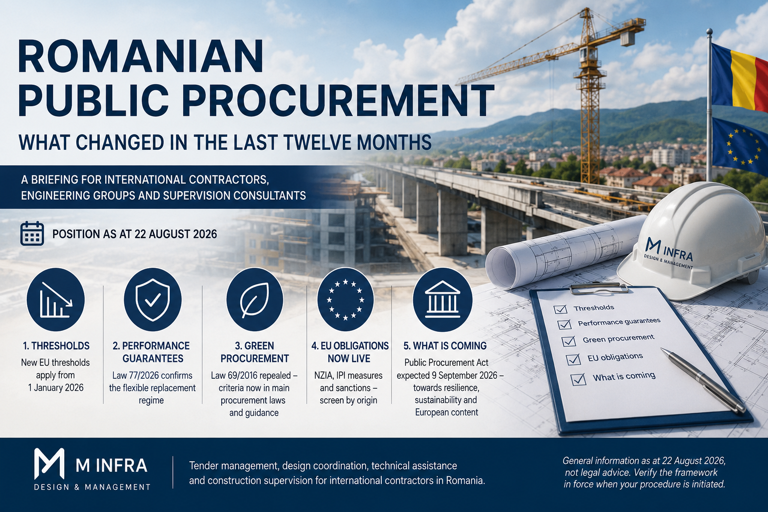
Between August 2025 and August 2026 the framework moved on four fronts: thresholds, performance guarantees, green procurement, and EU-level obligations that now bite directly. A fifth item — the wholesale rewrite of EU procurement law — is on the horizon and worth planning for now.
1. New thresholds since 1 January 2026 (and works went down)
The European Commission adopted Delegated Regulations (EU) 2025/2150, 2025/2151 and 2025/2152 on 22 October 2025, published in the Official Journal on 23 October 2025. These revise the thresholds in Directives 2014/23/EU, 2014/24/EU and 2014/25/EU for the 2026–2027 cycle. They are directly applicable and were transposed into practice in Romania through an ANAP notification, applying to all procedures launched from 1 January 2026.
The lei equivalents (all VAT-exclusive, at a conversion rate of 4.9890 RON/EUR):
Law 98/2016 — classic public procurement (OJEU publication obligation)
| Contract type | 2026–2027 | Previous | Direction |
| Works | 26,960,556 lei (€5,404,000) | 27,334,460 lei | Down |
| Supplies & services — central authorities | 698,460 lei (€140,000) | 705,819 lei | Down |
| Supplies & services — sub-central authorities | 1,077,624 lei (€216,000) | 1,090,812 lei | Down |
| Social and other specific services | 3,741,750 lei (€750,000) | 3,701,850 lei | Up |
Law 99/2016 — utilities
| Contract type | 2026–2027 | Previous |
| Supplies & services | 2,155,248 lei (€432,000) | 2,186,559 lei |
| Works | 26,960,556 lei (€5,404,000) | 27,334,460 lei |
| Social and other specific services | 4,989,000 lei (€1,000,000) | 4,935,800 lei |
Law 100/2016 — works and services concessions: 26,960,556 lei (€5,404,000), down from 27,334,460 lei.
Small-lot exemption (both regimes): 399,120 lei (€80,000) for supplies and services; 4,989,000 lei (€1,000,000) for works.
What did not change: the national direct-award thresholds under Art. 7(5) of Law 98/2016 remain 270,120 lei for supplies and services and 900,400 lei for works. These are set in lei by domestic statute and are unaffected by the EU biennial revision.
Practical read: the works threshold fell slightly, so a marginally larger set of contracts now requires full OJEU publication. If you are pricing a project close to €5.4 million, check which side of the line your estimated value falls on before assuming a simplified procedure.
2. Performance guarantees — the 2024 emergency regime is now confirmed by statute
Emergency Ordinance 19/2022 introduced flexibility on performance bonds after a major Romanian insurer lost its authorisation and entered insolvency, leaving contractors holding worthless instruments on live public contracts. GEO 3/2024 (Official Gazette No. 81 of 29 January 2024) extended and refined that regime.
The change in the reporting period: Parliament approved GEO 3/2024 through Law No. 77 of 26 May 2026, published in Official Gazette No. 445 of 26 May 2026 and promulgated the same day. What had been an emergency ordinance is now settled primary law.
The substance contractors should know:
- Where the issuing insurer’s authorisation is withdrawn, or bankruptcy proceedings open, the contractor must constitute a replacement performance guarantee at the contracting authority’s request, on a timetable aligned with insolvency law (Law 85/2014).
- The replacement may use any statutory method — bank transfer, an instrument issued by an insurer or credit institution, or successive retentions from partial invoices — including successive retentions where the tender documentation did not originally provide for them, and including a combination of two or more methods, where both parties agree.
- Guarantee instruments may take the form of co-insurance contracts (Civil Code Art. 2,239) or Community co-insurance (Law 237/2015, Art. 125).
- The resulting contract amendments are treated as falling under Art. 221(1)(e) of Law 98/2016 and Art. 240(2) of Law 99/2016 — i.e. they do not require a fresh procurement procedure.
- The regime also covers contracts governed by GD 1/2018 general and specific conditions, which is the FIDIC-derived framework used on most publicly funded investment objectives.
Practical read: if your surety is a Romanian insurer, confirm its ASF authorisation status before financial close, and build the replacement mechanism into your subcontract chain. The law gives you options — but they are exercised at the employer’s request and, for some of them, only by agreement.
3. Green procurement — the standalone law is gone
Law 69/2016 on green public procurement was repealed by Art. II of GEO 3/2024, and that repeal is now confirmed by Law 77/2026. The reasoning, set out in the ordinance’s preamble, was that the National Public Procurement Strategy 2023–2027 (approved by GD 554/2023) had identified Law 69/2016 as partly inapplicable, and that environmental requirements belonged inside the main procurement legislation rather than in a parallel statute.
Green criteria therefore now reach tenders through:
- the general provisions of Laws 98/2016 and 99/2016 (technical specifications, award criteria, contract performance conditions, life-cycle costing);
- ANAP Order No. 2,395/2023 on ecological criteria for product categories with whole-life environmental impact;
- sector-specific EU instruments that apply directly (see section 4).
Practical read: do not look for a single green procurement code. Environmental requirements will appear in the tender documentation itself, and their legal basis will vary. Read the caiet de sarcini rather than the statute book.
4. EU obligations that now apply directly
Net-Zero Industry Act (Regulation (EU) 2024/1735). The public procurement obligations in Article 25 have applied since 30 December 2025. For procedures covering listed net-zero technologies, contracting authorities must apply minimum environmental sustainability requirements — now specified in Commission Implementing Regulation (EU) 2026/718 of 20 March 2026 — plus at least one of three additional elements: a social or employment-related special condition, a cybersecurity compliance requirement, or a contractual charge for late delivery. A separate “resilience contribution” applies where the Commission has identified excessive dependence on a single third country for a technology or its main components; in those cases sourcing from the listed country is capped. The Commission published guidance on Articles 25 and 26 on 22 July 2026, responding to questions raised since the obligations became applicable.
International Procurement Instrument. Commission Implementing Regulation (EU) 2025/1197 of 19 June 2025 restricted access of Chinese economic operators and Chinese-origin medical devices to EU public procurement of medical devices, under Regulation (EU) 2022/1031. The sector is narrow, but the precedent matters: third-country origin is now an operative eligibility question in EU procurement, not a theoretical one.
Russia-related restrictions under Art. 5k of Regulation 833/2014 continue to apply and continue to be extended; ANAP issues notifications as new sanctions packages are adopted. Consortium and subcontractor screening remains a live compliance task on every bid.
5. What is coming: the EU Public Procurement Act
The Commission’s 2026 Work Programme announced a Public Procurement Act — the first structural overhaul of EU procurement law since 2014. The Commission published its evaluation of the current directives on 14 October 2025 and ran a public consultation that closed on 26 January 2026.
Commentary on a leaked draft indicates the Commission intends to replace Directives 2014/23/EU, 2014/24/EU and 2014/25/EU with a single, directly applicable Regulation, covering public contracts, utilities and concessions together, with greater emphasis on strategic procurement, economic security and third-country participation, expanded digitalisation, and a fundamental revision of the procedures themselves. Law firm commentary in July 2026 pointed to an anticipated official publication date of 9 September 2026.
Treat that date and the draft’s contents as expected rather than settled — the proposal had not been formally published as at the date of this note, and drafts change.
Even on an optimistic timetable, negotiation plus national implementation means real-world effect towards the end of the decade. The direction of travel, however, is clear enough to plan around: away from lowest price, towards non-price criteria, resilience and European-content considerations.
At national level, ANAP has draft normative acts in public consultation, including a draft emergency ordinance amending procurement legislation and a draft ordinance on a national centralised procurement office. Content and timing should be checked directly on ANAP’s decisional transparency page before relying on either.
What we would tell a client bidding in Romania this autumn
- Recheck your threshold analysis for any procedure launched after 1 January 2026, particularly works contracts near €5.4 million.
- Stress-test your performance security. Verify the surety’s ASF authorisation; know your Law 77/2026 replacement options; mirror them in subcontracts.
- Stop looking for a green procurement statute. Environmental criteria live in the tender documents now. Price the compliance cost at bid stage, not at execution.
- Screen the supply chain for origin, not just capability — NZIA resilience criteria, IPI measures and sanctions all operate on origin.
- Watch the award criterion. Restrictions on using lowest price/cost for intellectual services and for design-and-build or services on TEN-T transport infrastructure and county roads are a live feature of the framework, reinforced by the confirmation of GEO 52/2024 through Law 118/2025 (Official Gazette No. 619 of 1 July 2025). Confirm the exact criterion and weightings in each tender rather than assuming.
M Infra Design & Management S.R.L. advises international contractors and engineering groups on tender documentation, bid strategy, design coordination, technical assistance, construction supervision and contract management in the Romanian public procurement market.