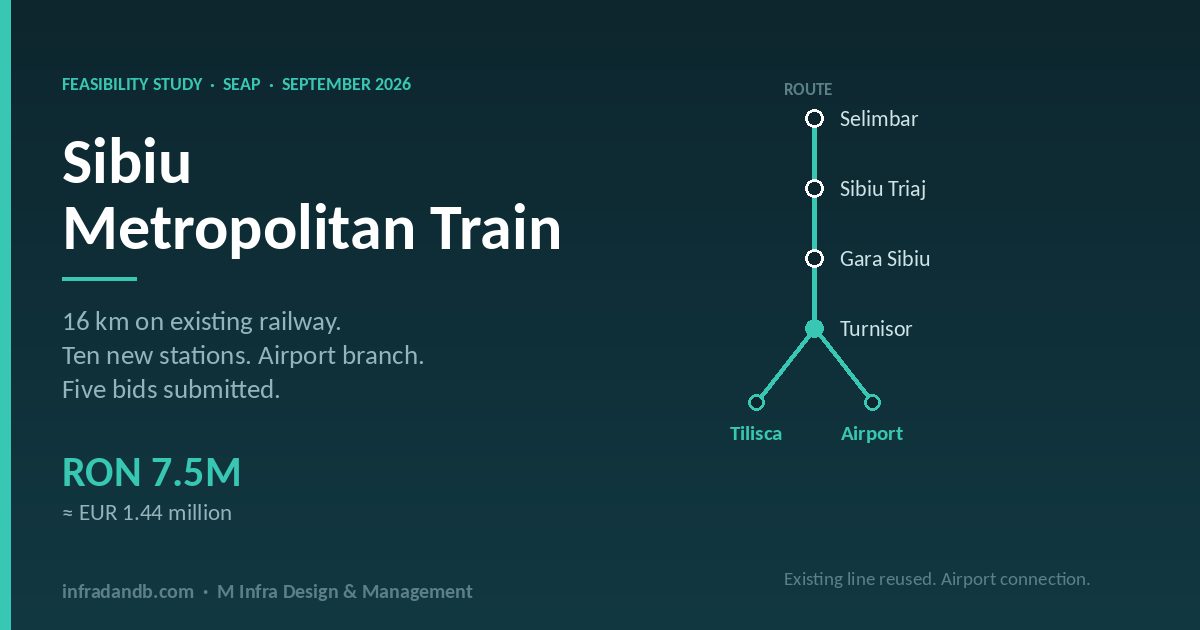
Five offers were submitted for the contract “Services for the preparation of technical-economic documentation for the project Introduction of electric transport – Sibiu Periurban Train, Phase: Feasibility Study (SF)”, tendered in SEAP in mid-July 2026.
Estimated contract value: RON 7,500,000, approximately EUR 1.44 million at an indicative 5.2 RON/EUR.
A disclosure before anything else. M Infra Design & Management is one of the bidders, as part of a consortium led by ECO Geodrum, together with Infra Centrum Doradztwa. The procedure is under evaluation. For that reason this article describes the project and the market interest it attracted — it makes no comment on the other bidders and no prediction about the outcome, and nothing here should be read as either.
Who bid
Five offers were submitted by the deadline, three individual and two in consortium:
| Bidder |
|---|
| TPF Inginerie — individual |
| Metroul SA — individual |
| Baicons Impex — individual |
| Specialist Consulting SRL (leader), 3TI Progetti Italia – Ingegneria Integrata S.p.A., Specialist Smart Group |
| ECO Geodrum (leader), M Infra Design & Management SRL, Infra Centrum Doradztwa |
Two observations that are safe to make while evaluation is running.
Five bids is a healthy field for a Romanian feasibility study. The European Court of Auditors has repeatedly flagged declining competition and the rise of single-bid procedures in EU public procurement — a concern the Commission cited directly when proposing its new Public Procurement Regulation this month. Against that backdrop, five compliant-looking offers on a EUR 1.4 million design study is a good signal about the project itself.
Two of the five consortia include a foreign partner — Italian in one, Polish in ours. For a study of this scale, that is a reasonable indicator that the project reads as technically interesting outside Romania, not merely as a local contract.
What the project actually is
The Sibiu metropolitan train — TMSib — is a roughly 16-kilometre route running on existing railway infrastructure rather than new alignment.
The core corridor links Gara Șelimbăr, Sibiu Triaj, Ateliere Zonă, Gara Sibiu, halta Sibiu and Halta Turnișor. From Turnișor the route branches in two directions:
- Along the national railway to a future station in the Tilișca district, towards Cristian
- Along the Moara Cibin industrial railway line to Sibiu International Airport and the West Industrial Zone
That second branch is the most commercially interesting feature. Converting an industrial freight line into a passenger connection to an international airport is a materially different engineering problem from building new track, and it is the kind of reuse that makes metropolitan rail affordable in mid-sized European cities.
Scope of the study
The feasibility study must address:
- Electrification of the line, or infrastructure for battery or hydrogen traction vehicles
- Grade-separated crossings at road intersections
- A minimum of ten new passenger stations
- Acquisition of light electric rail vehicles
The option set on traction is worth noting. A study that must genuinely compare overhead electrification against battery and hydrogen alternatives is not a formality — the three options have entirely different capital profiles, depot requirements and operating economics, and the comparison is where the study earns its value.
The ten stations
Station distribution is specified: three on the industrial line between Turnișor and the future Aeroport – Str. Lyon station, three on the Turnișor – Tilișca section towards Cristian, and four on the Șelimbăr – Turnișor entry section.
Platforms follow technical specifications for interoperability: 55 cm height, 150 to 250 metres length, minimum 3.05 metres width.
Mandatory platform equipment is unusually prescriptive for a feasibility-stage document:
- Lighting columns powered by photovoltaic panels
- Separated waste collection modules
- A shelter with benches for a minimum of ten people
- Passenger information panels
- Tactile guidance strips for visually impaired passengers
- Protective fencing
Intermodality requirements
Park & Ride facilities at a minimum of 30% of stations — preferably the extra-urban ones — including one at the route extremity, with at least 15 spaces each.
Every station requires a short-stay kiss & ride area and storage for a minimum of 20 bicycles or scooters.
That last requirement, applied to every station rather than a subset, tells you the project is designed around last-mile access rather than around the train alone.
Rolling stock and service
Vehicle requirements include dedicated spaces for passengers with disabilities, for bicycles and for bulky luggage; WiFi; and electronic ticketing integrated with local public transport.
Notably, the documentation states that on-board toilets are not required, given the short-distance character of the service. Instead, a minimum of one unisex public toilet is specified at each railway station — a design decision that shifts cost from rolling stock to fixed infrastructure and simplifies vehicle procurement.
Service frequency targets: preferably at least 4 trains per hour at peak, at least 2 per hour off-peak. Minimum commercial speed: 30 km/h.
Those figures define the project more precisely than the route map does. Four trains per hour at peak on a 16 km route using existing infrastructure implies specific requirements on signalling, passing loops and depot capacity — and those requirements are exactly what a feasibility study exists to quantify.
Why this project matters beyond Sibiu
Romania has very little metropolitan rail. Where it exists, it tends to be a timetable overlay on existing regional services rather than a purpose-designed urban system.
Sibiu is attempting something different: a dedicated periurban service, on reused infrastructure, with airport and industrial-zone connectivity, TSI-compliant platforms and integrated ticketing. If the feasibility study produces a financeable project, it becomes a template that other Romanian cities of comparable size can point to.
That is the reason a EUR 1.4 million study attracted five bids, including two international partnerships. The study is small. What follows it is not.
What comes next
The evaluation is ongoing. After it concludes, the winning bidder prepares the feasibility study, which in turn determines whether the project proceeds to design and execution, and under what financing.
I am not going to speculate on timelines. Feasibility study contracts of this type typically run many months, and the interval between study completion and any works tender depends on financing decisions that have not yet been taken.
Mădălin Matica General Manager – M Infra Design & Management S.R.L.
M Infra provides tender management, technical documentation, design coordination and contract management for the Romanian public procurement market, working predominantly with international contractors and engineering groups.
This article is based on publicly available information published in SEAP and reported in the Romanian railway press. M Infra Design & Management is a member of one of the bidding consortia; the procedure is under evaluation at the time of writing. Euro figures use an indicative 5.2 RON/EUR rate and are not official conversions.