European Commission proposal adopted 9 September 2026
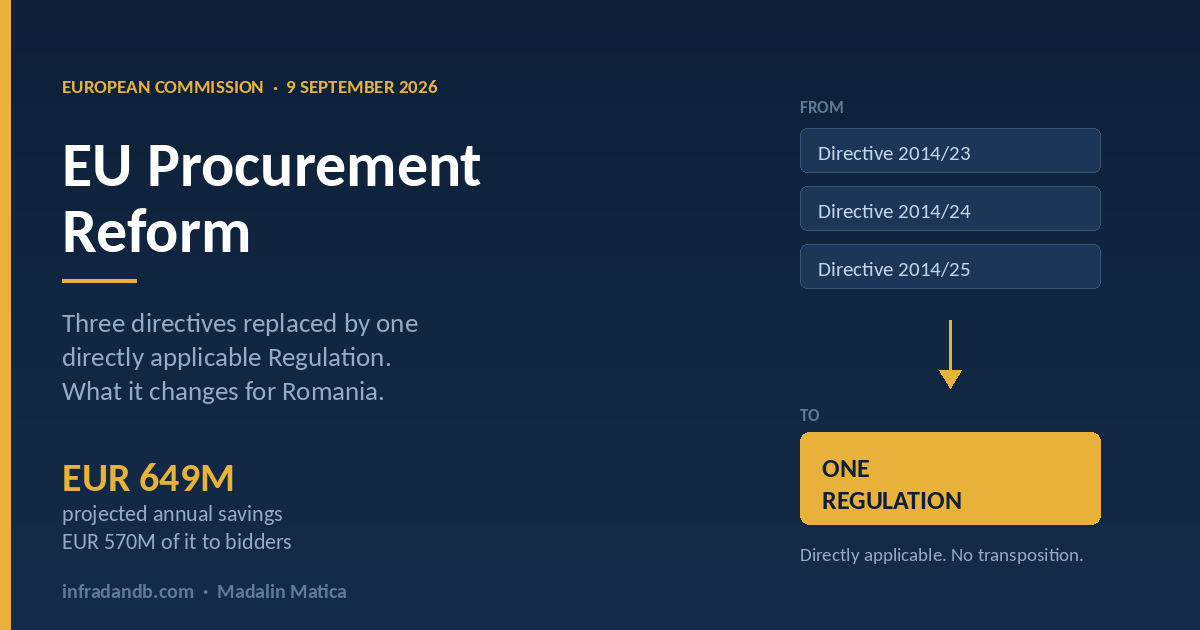
On 9 September the European Commission adopted a proposal for a new Public Procurement Regulation — a single, directly applicable instrument intended to replace Directives 2014/23/EU, 2014/24/EU and 2014/25/EU, together with procurement provisions currently scattered across sector-specific legislation.
Executive Vice-President Stéphane Séjourné described the move from three directives to one regulation as a radical simplification.
The Commission projects annual administrative savings of EUR 649 million — EUR 80 million for public buyers and EUR 570 million for economic operators. Public procurement accounts for roughly 15% of EU GDP, around EUR 2.5 trillion in 2025.
Reporting on the proposal notes the rulebook would shrink from roughly 900 pages to about 200.
The proposal now goes to the European Parliament and the Council. Nothing changes yet, and I would not put a date on when it will. Files of this scale typically take years, and the text that eventually enters into force is rarely the text that entered negotiation.
But the direction of travel matters now, because it determines what is worth building capability around.
The single word that matters: Regulation
For anyone working in Romanian procurement, the most consequential feature of this proposal is not any individual rule. It is the instrument.
Romania’s current framework — Law 98/2016 for classic procurement, Law 99/2016 for sectoral, Law 100/2016 for concessions — exists because directives require national transposition. Each Member State transposes in its own way, adds its own requirements, and produces its own body of interpretation and guidance.
A Regulation applies directly. No transposition. No national variation in the core rules. Substantially less room for what the Commission’s own analysis calls divergent national transposition choices — and what the industry calls gold-plating.
If you have ever explained to a foreign client why a Romanian procedure requires something their home market does not, despite both flowing from the same directive, you already understand what this proposal is aimed at.
What the proposal actually contains
Simpler and clearer rules
Three procedures instead of five. Consolidation into one instrument, with procurement provisions currently dispersed across sector-specific legislation brought into a single coherent framework.
Negotiation becomes normal. The proposal gives public buyers greater flexibility to negotiate with applicants during procedures, encourages market consultation, and explicitly aims to make public procurement more like private procurement.
That last phrase deserves attention. In current Romanian practice, negotiation is the exception and clarification is tightly bounded. A framework that normalises negotiation changes not just the rules but the skill set required to bid.
A new innovation procedure for developing and acquiring solutions not yet available on the market.
One digital marketplace across the EU
The proposal creates an integrated digital procurement marketplace built from interconnected, interoperable Member State eProcurement platforms.
Three practical consequences:
- Automatic verification of exclusion criteria for public buyers
- Companies can participate and submit tenders across the EU through any connected platform
- The ‘once-only’ principle — no repeated requests for the same information and documentation
For a foreign contractor, this is the most commercially significant element in the entire package. Today, bidding in Romania means registering in SEAP, obtaining a Romanian qualified electronic signature, and assembling a documentation set in Romanian. Under the proposed architecture, an operator registered on any connected platform could bid into Romanian procedures.
That lowers the entry cost to the Romanian market considerably. It also raises the number of bidders any Romanian contractor will face.
Best Price-Quality Ratio becomes the standard
This is the change with the most direct effect on how offers are built.
BPQR becomes the standard award method, with quality criteria accounting for at least 30% of the award criteria — 50% for labour-intensive contracts — subject to a comply-or-explain mechanism. A contracting authority may deviate, but must explain how quality will otherwise be ensured, for instance through minimum quality requirements.
Public buyers will have to systematically consider not only price but quality, including environmental, social, innovation, security and resilience, and European preference considerations. They retain full discretion over which quality criteria to apply and in what proportion.
Romanian practice already moves in this direction — the procedures I have analysed recently allocate 50%, 60%, even 70% of the score to technical factors. A 30% floor would formalise a trend rather than reverse one. But it would end the lowest-price procedure as a default option for a large share of contracts.
Security, resilience and European preference
Following the Draghi and Letta reports, the proposal reflects the geopolitical dimension of procurement. It enables, and in some cases requires, public buyers to address risks relating to security and public safety, sensitive information, cybersecurity, and undue third-country influence.
New provisions on resilience and security of supply would apply to contracts involving entities linked to critical infrastructure, supporting supply chain diversification and crisis preparedness.
The Regulation introduces a horizontal European preference framework, clarifying which operators and products are covered by the Union’s international procurement commitments. The Commission would be able to restrict that coverage where a market access analysis establishes that a third country has failed to grant EU operators fair access, or where restrictions are needed to avoid security-of-supply dependencies.
Press reporting indicates the framework would allow authorities to exclude bids with less than 50% European content by value, and that the measures stop short of a blanket “Buy European” requirement. That threshold comes from reporting rather than from the Commission’s own press release — worth verifying against the legal text before relying on it.
What this means in Romania specifically
Four observations, offered as reasoning rather than prediction.
1. The competitive advantage of knowing national quirks would erode.
Part of the value of a Romanian procurement adviser today lies in knowing how Romanian authorities interpret and apply rules that originate in Brussels but arrive filtered through Law 98/2016, ANAP guidance, CNSC decisions and local habit. A directly applicable Regulation compresses that filter.
I say this as someone whose business is built partly on that knowledge. The honest read is that harmonisation moves the value from knowing local rules toward understanding the market, the authorities and the competition — which is the harder and more durable half anyway.
2. Romanian contractors would face more foreign competition, sooner.
The once-only principle and cross-platform bidding remove real friction. A Spanish or Italian contractor who currently rules out Romanian tenders on administrative grounds would have fewer reasons to. Romanian operators accustomed to a limited domestic field should read this as a competitive warning, not just an administrative simplification.
3. The technical proposal becomes even more decisive.
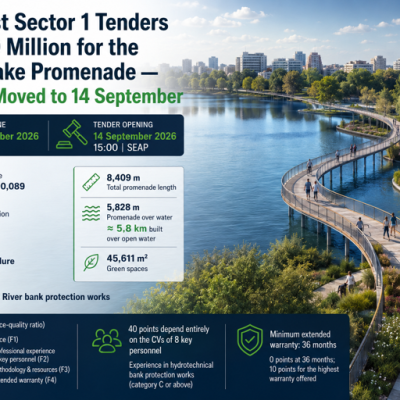
If quality must carry at least 30% and authorities must justify departing from that, the written technical offer stops being a compliance document and becomes the primary competitive instrument. Romanian procedures already reward this — I have recently analysed one where 20 of 100 points depended purely on how the methodology was drafted. A regulatory floor would make that universal.
4. European preference cuts both ways for Romanian industry.
For Romanian manufacturers — naval, rolling stock, construction materials — a formalised European content framework is an opportunity. For Romanian contractors sourcing equipment and components from outside the EU, it is a supply chain question that needs answering before it appears in a tender specification rather than after.
The honest caveat
This is a proposal. It will be negotiated by the European Parliament and the Council, and both institutions will change it. Quality thresholds, the European preference framework and the digital marketplace architecture are all contested in ways that will surface during negotiation.
I am not going to guess at an entry-into-force date, and I would treat any article that does with scepticism.
What is reasonable to conclude now is narrower: the direction is toward harmonisation, toward quality-weighted award, toward cross-border access and toward strategic and security considerations in procurement. That direction has been consistent across the Draghi report, the Letta report, the Single Market Strategy and now a legislative proposal. It is unlikely to reverse.
Capabilities that pay off under that direction — writing technical proposals that win on quality, structuring consortia across borders, understanding supply chain origin — are worth building now. They are useful under the current framework too, which makes the investment low-risk regardless of how the negotiation ends.